
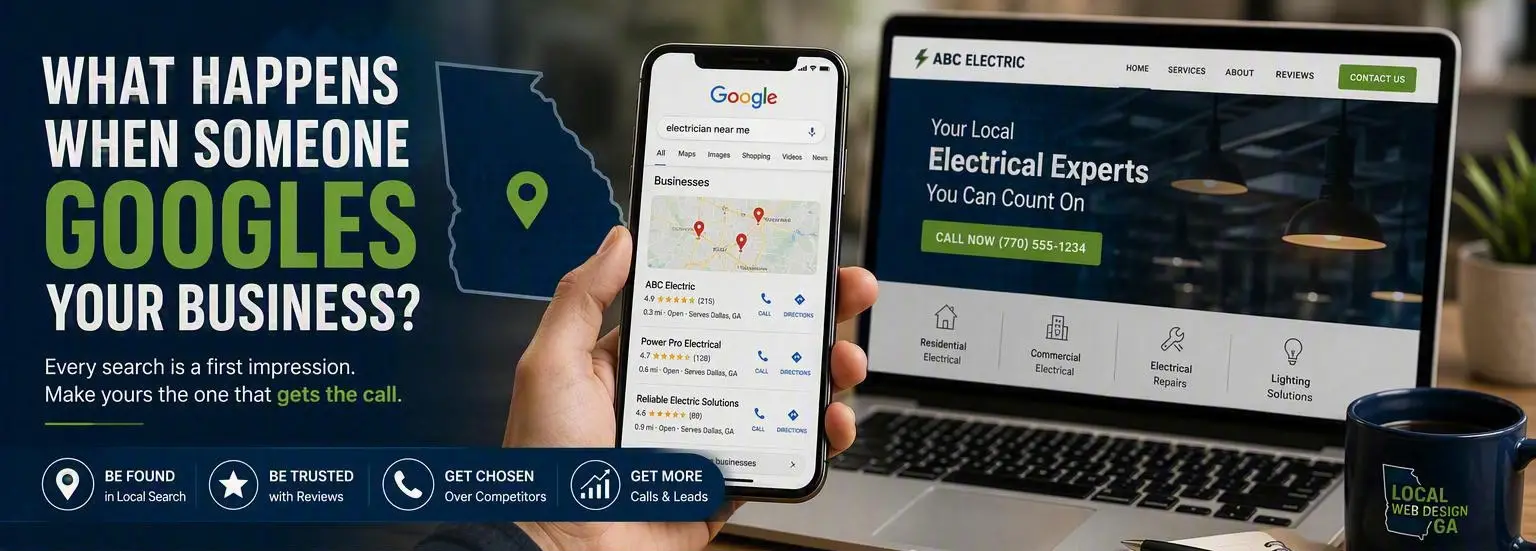
What Happens When Someone Googles Your Business?
Most business owners assume that when a potential customer searches for their company, the customer simply finds the website and makes a call.
That’s not actually what happens.
Whether someone is searching for your company by name or looking for the services you offer, they’re making decisions long before they ever visit your website.
In many cases, they decide whether to contact you in less than a minute.
Understanding what customers see when they Google your business can help you identify opportunities you’re missing and improve your chances of turning searches into phone calls.
Let’s walk through the process.
Step 1: The Search Begins
Imagine someone in Georgia needs a service you provide.
Maybe they’re searching for:
- Electrician near me
- HVAC repair in Dallas GA
- Local web designer
- Pressure washing service
- Roofing contractor
Or perhaps they’ve already heard about your business and are searching for your company name directly.
Either way, Google’s job is to show the searcher the businesses most likely to solve their problem.
Your job is to make sure your business deserves to appear there.
Step 2: Your Google Business Profile Appears
For most local businesses, the first thing a customer sees isn’t the website.
It’s your Google Business Profile.
This profile often includes:
- Business name
- Phone number
- Reviews
- Ratings
- Photos
- Business hours
- Directions
- Website link
- Service area
At this point, a surprising number of customers decide whether to contact you without ever visiting your website.
Think about your own behavior.
If you’re looking for a local service and one business has 150 reviews, detailed photos, and current information while another has 4 reviews and missing details, which one are you more likely to call?
Your Google Business Profile isn’t just a listing.
It’s often your first impression.
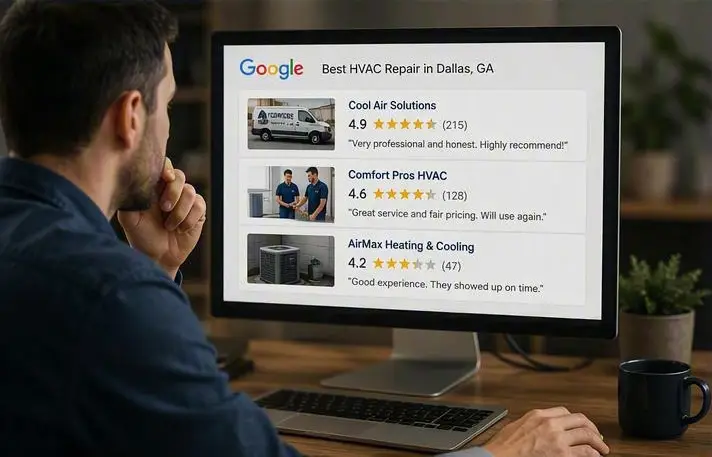
Step 3: Customers Check Your Reviews
Before they click your website, many customers immediately look at reviews.
They want answers to questions like:
- Can this business be trusted?
- Do they answer the phone?
- Are customers satisfied?
- Do they show up when they say they will?
- Would I hire them?
Reviews build confidence.
Even if your business has excellent service, customers can’t know that until they see evidence from other people.
Consistently gathering authentic reviews is one of the easiest ways to improve both visibility and conversion rates.
Step 4: They Visit Your Website
Now the customer clicks.
The clock starts ticking.
Most visitors decide very quickly whether a website feels trustworthy.
Within seconds they’re subconsciously evaluating:
- Does this look professional?
- Is it easy to use?
- Can I find what I need?
- Does this business appear legitimate?
- Can I contact someone quickly?
A website doesn’t need flashy animations or complicated features.
It needs to answer questions clearly and make it easy for visitors to take action.
The best business websites remove friction instead of creating it.
Step 5: They Compare You to Competitors
This is where many businesses lose potential customers.
The customer doesn’t view your website in isolation.
They’re comparing you directly against everyone else on the search results page.
They may open three or four websites at once and compare:
- Reviews
- Experience
- Services
- Pricing information
- Location
- Professionalism
- Trust signals
If your competitors make a stronger first impression, they often win the call.
That’s why a website should never be treated as an online brochure.
It’s a sales tool designed to help customers choose you.
Step 6: They Look for Reasons to Trust You
Trust matters.
Especially when a customer is about to spend money.
Potential customers look for evidence such as:
- Customer reviews
- Testimonials
- Project photos
- Certifications
- Service guarantees
- Years in business
- Local experience
The more proof you provide, the easier the decision becomes.
People naturally prefer businesses that look established, experienced, and trustworthy.
Step 7: They Decide Whether to Contact You
Eventually, every visitor reaches a decision.
They either:
- Call
- Fill out a form
- Request a quote
- Send an email
Or they leave and continue searching.
This is why clear calls to action matter.
Don’t make people work to find your phone number.
Don’t hide your contact form.
Don’t force visitors to hunt for information.
Make taking the next step simple.
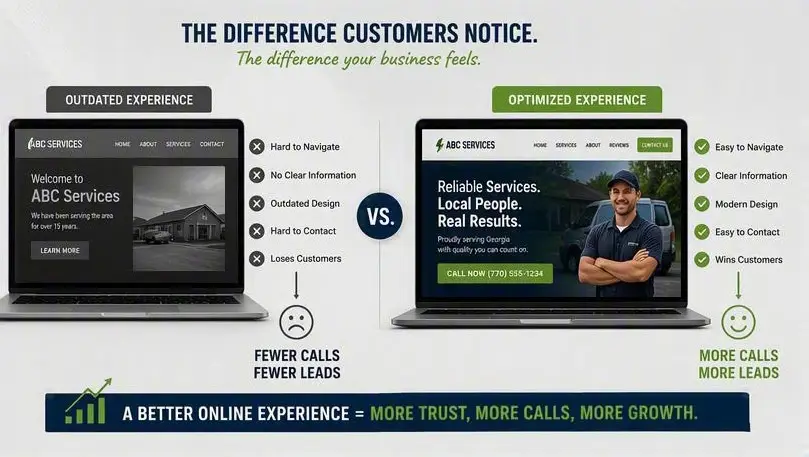
Why Some Businesses Get More Calls Than Others
Many business owners assume their competitors are winning because they’re spending more money on advertising.
Sometimes that’s true.
But often, the difference comes down to visibility and presentation.
Businesses that perform well online typically have:
✅ An optimized Google Business Profile
✅ Strong customer reviews
✅ A fast website
✅ Mobile-friendly pages
✅ Clear service descriptions
✅ Professional photos
✅ Local SEO optimization
✅ Easy ways to contact them
When all of those pieces work together, Google sends more visitors and more visitors become customers.
What Customers See Matters
When someone Googles your business, they aren’t just evaluating your company.
They’re evaluating whether you’re the best solution to their problem.
Every review, photo, page, and piece of information influences that decision.
The good news is that most improvements don’t require a huge budget.
Small updates to your website, your Google Business Profile, and your online reputation can often have a significant impact on how customers find and choose your business.
The businesses that win online aren’t always the biggest.
They’re usually the businesses that make it easiest for customers to say “yes.”